
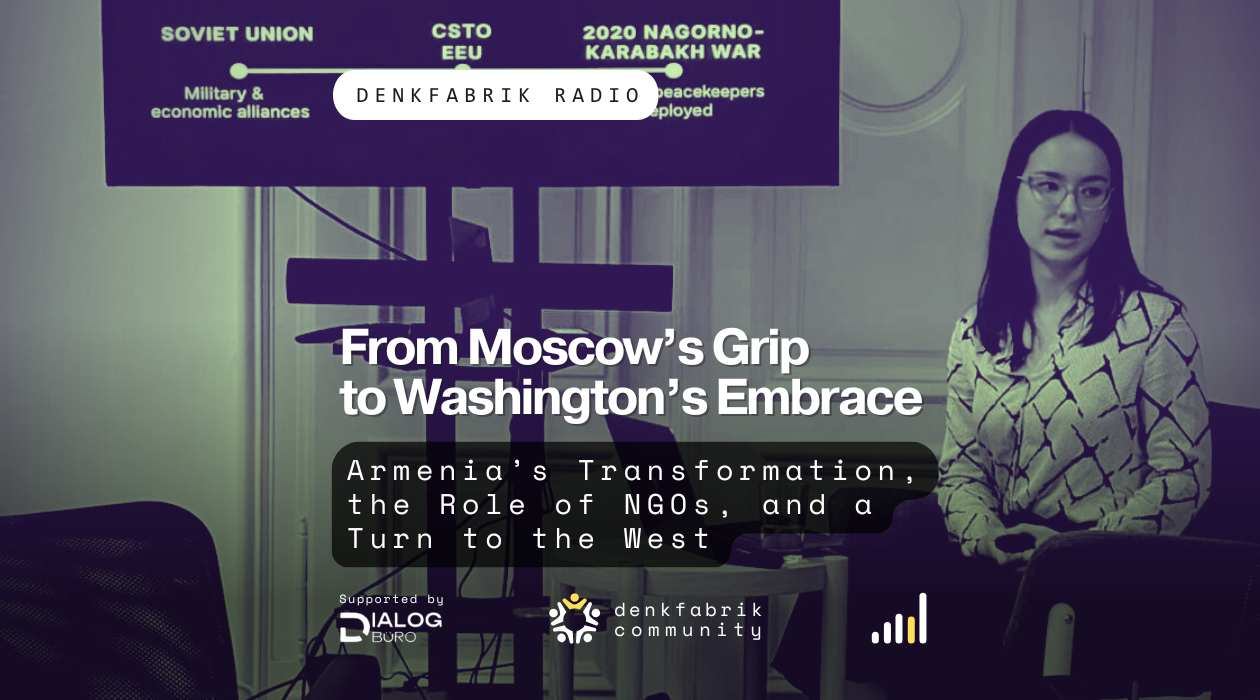
After years of dependence on Russia as its main security guarantor, Armenia is entering a new and uncertain chapter. The peace deal with Azerbaijan has reopened old wounds while forcing the country to rethink its alliances. For many Armenians, the idea of looking West is no longer abstract but a matter of survival and political identity. How does a nation rebuild its future while breaking away from the power that shaped its past?
Milana Bagdasarian, a political analyst who conducts policy research on security, democracy and civic engagement in the South Caucasus and Eastern Europe, guides through Armenia’s internal transformation, the fundamental change in its foreign policy and the influence of NGOs.
See the full transcript
I. Introduction: Geopolitical Importance and Humanitarian Crisis
So I believe that South Caucasus is a very important region, but unfortunately not so many people are following that because it seems that it’s far away, right? And it’s kind of unreachable that we are safe and what’s happening in Armenia, Azerbaijan, it shouldn’t matter to us. But right now it becomes quite mainstream since the signing of the peace agreement at Washington. And I think that’s why it’s gained so much attention. And also I believe… It’s maybe from the human rights perspective. There are a lot of talks at the OSCE in the human rights dimensions that there are a lot of war crimes being happening. There are a lot of, in general, crimes against humanity with this force displaced people because there are around 150 ,000 of people who were forcefully displaced to Yerevan from Nagorno -Karabakh region. So that’s why I believe it’s very important to understand the geopolitics in this region because I believe Armenia could be a very good member to the EU and to America because it has a very strong position in the region and all the security concerns regarding Armenian safety are the concerns of the EU because Russia has a strong presence there and we should not forget about this region.
II. Historical Dependence on Russia: Security, Economy, and Soft Power
Let’s kick in. So let’s first talk about the historical dependence on Russia, how it evolved, how it started. We both know that it started from Soviet Union in the 90s when Armenia was seeking for the security support. And that’s how in 1992 the STO was founded and Armenia was the main member of that because Armenia was seeking for protection from… Azerbaijan, and Turkey. So Armenia was one of the main members alongside with Russia, Kyrgyzstan, Kazakhstan, Uzbekistan, and Tajikistan. So that’s how it started. And then Russia established the 102nd military base. It’s the only one that’s right now operating in the South Caucasus region. In the city named Gumri, it’s the second largest city after Yerevan. And they have… around 3 ,000, 5 ,000 personnel working in this military base. And that’s why it gives a very strong security threat to the region and Russian influence. And this contract is active till 2044, the existence of this base and the operation of this base. But obviously, besides the security matters, We should not forget about the cultural ones because there are around 800 ,000 migrants from Armenia living in Russia. And all these people, they have high positions and they have quite a high influence on Russian politics because we can see a lot of people working for the Russian government. We see a lot of people working in the intellectual fields, in the arts. So they have quite a strong presence and influence. on the way Armenia is and otherwise that Russia has a strong influence because basically the amount of earned money and transferred money from these people who are working in Russia to Armenia is around 13 % of the Armenian GDP.
that Russia has a strong influence because basically the amount of earned money and transferred money from these people who are working in Russia to Armenia is around 13 % of the Armenian GDP. So it’s a very significant number. And we are talking out of 2 .5 million of Armenians who are living all over the world, right? So we are talking about big numbers. And that’s why it’s very important to understand that diaspora plays a huge role in security and in general in Armenia. But besides that, the other aspect is the church. Because church has a huge influence on Armenians. They are very religious people, and the church has very strong ties with Kirill, with the Russian church, right? And so that’s why they represent and they kind of lobby the interests of Russia as well. They project them. And then, obviously, the economic ties. Energy sector is fully 90 % of the bases, 90 % of the gas pipelines and also the plants are owned by the Russian private sector. So it’s a lot. So Armenia is fully dependent on Russia in terms of that. Besides that, there is a trade -off that Armenia is part of the EAEU union. basically representative of Russia, Armenia, Belarus, Kazakhstan and Tajikistan. It gives Armenia a privilege for the exports and imports without tariffs, with low tariffs, basically. And because of that, they have access to more than 800 million of the products. Mainly, they are specializing into the food manufacturing. So it’s like food export, like fruit mainly, because Armenia is famous for that. But also, it’s fabric manufacturing and all these type of things. But unfortunately, at the beginning, it seems like a breakthrough, this agreement, because Armenia gained around 70%. million, 70 million per year from this agreement. But unfortunately, later on, because Armenia established more protectionist policies for the trade, they lost a lot of customers from these countries and they lost a lot of producers as well. And that’s why it’s dropped significantly. 40 million per year, and the expectations were that they would make 150, 200 million per year. So you could see that the expectations and reality, they’re not meeting together. And that’s why it raised a lot of questions inside Armenia. Is it really a right path that we are taking? What are the benefits that we have from these agreements, both of these agreements from security perspective and economical perspective? A lot of people started rethinking that, especially when it comes to the NGOs, when it comes to the intellectual layer of Armenia. Because when we talk to the ordinary people, when we talk about the local businessmen, obviously they saw the benefit of that. Because there were very, I would say, low standards in terms of the quality of the products that they were exporting to Russia in comparison to the standards they have, let’s say, in the EU. or any other well -established, higher standards, less specific countries who are more protectionist about that. And besides that, there is a cultural aspect that Russian soft power is so efficient in South Caucasus and also Central Asian region that they have a lot of local… educational centers, for example, like Russian language centers, and also the double diploma programs that they have like a joint venture with the Armenian university, basically. And around 70 % of people speak fluent Russian in the region. So it says it’s actually very hard for this region in comparison to Azerbaijan, right?
III. The Peace Agreement and Corridor
So the peace agreement, right?
People were expecting that for a while. It was per the final draft in March. But there were a lot of conditions for this to happen. And the main concern was the change of the constitution that Baku has asked for. And unfortunately, it was impossible. Because he knew that based on the Armenian constitution, you need 25 % of people who would support the change. And it was obvious that there wouldn’t be even 25 % of supporters, right? Because it’s a very sensitive topic from the ethical perspective that a lot of people, for them, it’s their identity and it’s their land and it’s like historical memory. So that’s why this condition was not fulfilled. It was talked a lot throughout the OSCE meetings and conferences, and a lot of organizations, not only the Azerbaijan delegation, but a lot of Azerbaijani NGOs were repeating. But what about the change? Yeah, we can talk, but before the change would happen, there would be no signature on this paper, on this agreement. Despite that, they managed to sign in August, so quite recently in Washington. And it was a huge breakthrough politically speaking.
speaking. But when it comes to cultural and to people, it was a huge dissatisfaction. And basically people seen this agreement. as a betrayal and for the re-election of Pashninyan. Because re -elections are coming in 2026, right? So it will be quite soon. But let’s quickly go through this trip agreement.
So basically, under Trump, it was established that there would be a trip corridor that would be 42 kilometers and it would basically connect Azerbaijan, mainland Azerbaijan, with Armenia. So what were the benefits? For Azerbaijan, they shouldn’t be overcrossing the trade with Turkey through Iran. So it would save a lot of money for them. And as for Armenia, it was infrastructure investments that Americans would invest into the railways, that Americans would invest into the energy infrastructure, because as I previously mentioned, all energy infrastructures. 90 % owned by the Russian private companies and oligarchs. So it gives a lot of space for development for Armenia. But there are a lot of claims about the security, how this agreement, how this corridor would ensure the security for Armenia. Besides the humanitarian crisis and that all this ethnic genocide would go off the Azerbaijan hands, the other question would be how to ensure that the influence from the West wouldn’t change the internal affairs of the country. Because they were discussing as well the change of the constitution during the meeting, right? And people would pursue that as a direct threat to the public affairs interference. After signing this agreement, obviously, it led to termination of the Minsk group. So basically, it was a trilateral mediation attempt from Russia, from US and France, which had not succeeded. So they sent a formal letter to the OSCE. So right now it’s fully dissolved, this agreement.
IV. Shift Away from Russia: CSTO Failure and Decline of Trust
So why is this moment is so different? So let’s go back a little bit and start from February 2022, from the full -scale invasion of Russia and Ukraine. All the members of the South’s caucus thought that it would be an easy win. Because nobody ever questioned Russian power, Russian military power. And they believed that Russian invisibility is something like de facto. But then, when it started and they’ve seen that Russia is not moving further, that it’s not in the best position and they haven’t ended through our three days as they promised, they started questioning. Should we really rely on the CSTO agreement with Russia? Would they really protect us if they can’t even help themselves? And so this type of questions started arising in Armenian government. And as for Azerbaijan, they saw it as a great opportunity because, yeah, Russia is fully taken with Ukraine and don’t have any capacity to stand the arms and or military, right? So they were like, okay, Russia can’t do anything to fight with us. So let’s use this opportunity. And they did. And after this, during Second Nagorno -Karabakh War, Azerbaijan fully deployed their forces. And the most crucial moment, I would say, it was in September 2022. when they even crossed the integrity of Armenia, the borders with Armenia, and they killed hundreds of the military personnel. And as for the response, Armenians obviously reached out to the fourth protocol of CSTO that Russia would immediately step in and immediately help the military in terms of the weapons and also with the soldiers. But obviously Russia… didn’t have resources. And the only recommendation that they followed is please try to make a political peace through diplomacy. We don’t have the capacity. Later on, of course, they sent the assessment mission to Nagorno -Karabakh as peacekeepers. And it was around 4 ,000 people were sent there as peacekeepers. But obviously, the peacekeepers could not intervene. only in the case where their own lives are endangered. So obviously that was not the case because Azerbaijan knew if they would try to do anything with the Russian peacekeepers, the reaction would follow immediately. And the other problem was that this deployment was made already when Azerbaijan had a dominant position. They had this 24 -hour operation. throughout which they forcefully displaced over 100 ,000 people to Yerevan from the Nagorno -Karabakh region. And they had basically all power over the corridors, right? So Russia sent these people kind of de facto, as a sign that they are still following the CSTO. But in reality, it was just, yeah. And afterwards, Pashinyan, Prime Minister of Armenia, he was very displeased, let’s put it this way, as well as all the civilians, all the people in Armenia. And they questioned, should we really continue with this path? Should we really rely on Russia? Because if we look in 2011 till 2020, 94 % of the armed export was coming from Russia. So it was all the weapons, it was the vests, and basically everything, right? Even tanks were coming from Russia. But afterwards, when the real attack unveiled,
the response was nothing. And you can see that the trust in Russia There was an independent survey by the International Republic University that has shown the trust in Russia and in OSTO in 2018. It was around 87%. And then in 2023, it dropped down to 32 % to Russia. Meanwhile, the trust in America was 37%. The trust in France was 32%. And the trust to Iran was 30%. So this number says a lot about the shift. And it was one of the major shifts in the region towards the position to Russia.
V. Internal Political Consequences and Opposition Unification
And, of course, it caused the internal consequences, the political consequences, if we talk about the peace agreement that has happened. So, basically, the Pashinyan legitimacy and approval fell from 87 % to 13%.
Basically, what we see is that his re -election chances are close to zero. And that people believe that his foreign policy is a total failure. Because besides the security concerns, there are also corruption concerns. Because there are a lot of opposition members. who were conducting independent investigations about the funds allocations on different infrastructure projects and so on and so forth that concluded about the gaps that are lacking, the money that is lacking. But obviously, the main disapproval was still from this peace agreement rather than the internal affairs. As well as the constitutional dilemma. As I mentioned before, because they had a ratification of 1999 about independence of Armenia and about the Karabakh territory as a part of Armenia. And it was kind of a path, like a sovereignty path versus pragmatism. And Pashinyan, he took in the pragmatism path. Because the other opposition parties… They are pushing more into the historical memories and sovereignty of the country. And they believe that the sovereignty also comes from the Nagorno -Karabakh territory. And that’s why they built their main oppositional campaigns on that, on this agreement and on this failure, let’s put it this way. And also church is putting fire in the oil, that church still has very tight ties with Russia.
And they kind of unified together because usually, previously, if you look at Armenian opposition, it was very disbalanced. Nobody was working together. And that’s why it was so hard for this opposition to succeed because they didn’t even have even one field of agreement, one sphere of the agreement where they could like unite together and work on it together. But now it helped to actually unify the opposition. plus diaspora and plus opposition parties. So they started working as a whole mechanism together on the idea of Nagorno -Karabakh and its identity.
VI. Societal Shift and Rise of Civil Society
So obviously there is a consequences that are societal, that there is a huge shift of the identity. Previously, Armenians were fighting for the idea of its independence of their territory of Nagorno -Karabakh, and it was kind of uniting them together. But now, once I would say younger generation have seen opportunity into the Western partnership, it became polarized. Because previously, it was still majority supporting Russia, right? and seeing only this opportunity. And yeah, that Armenians, younger Armenians are more open to the Western integration because besides the economical benefits that Armenia has, it’s also educational programs. There are a lot of grants with America and with EU in general, which allow students to have stipend, to have free education. And it’s a huge opportunity because Armenians were always kind of striving to leave in order to learn something new and then return back and change something, right? Obviously, not all of them want to return, but a lot of them are patriotic and that’s why they’re returning back. So, yeah, so that’s why it was very strong. But as for the civil societies and NGOs, they also start being more active in this field. And you can see a lot of actually angels are right now represented in OSCE. If you go to the human dimensions conferences, there are around like eight organizations who are constantly there. And it becomes visible, especially it started like that since 2022, right? They became more active and more represented and more cohesive, I would say. And they also have a huge support of other international organizations because a lot of, for example, Freedom House, they started collaborating together on the investigations of war crimes investigations in Nagorno -Karabakh region and in general on the help for the displaced people from this region. So that was a huge breakthrough. for the local NGOs to kind of get into the international arena and start having their voice to be heard and start having this international cooperation.
VII. External Consequences: Russia’s Decline and EU/US Support
External consequences. So, yeah, as you could already imagine, that there is a huge Russian decline, that even the station, the 100 -second military base that they have in Gyumri, Yes, it is still there because they still have agreement until 2044. But it’s just like in documents, right? Because it’s not really operating. And there are still ongoing protests in Gyumri to close down this base. Even though it’s not really right now possible if we are legally speaking to terminate this contract that they have with Russia. But it shows a lot the reaction of people that they do not want to tolerate any presence of Russia or any Russian influence if it’s when it comes to soft power or when it comes to the security. So, yes, they’ve seen it as a total diplomatic failure, as if Russia has given a green light to Azerbaijan when they first recommended to to conduct this business through the diplomatic efforts and then when the peacekeepers haven’t done anything. And it caused the CSTO to be frozen from the Armenian side because Pashinyan made an official statement in November 2024 that Armenia would not after everything that has happened. that Armenia would not be interested to be part of this agreement, of this convention, and that they are withdrawing from that. But the other problem is that they still did not withdraw from the economic union that they had. And that should be a big step, next step from Armenia, because if they want to have a… further relationship with the EU or become an EU member, to raise the topic about EU membership, they should withdraw from that. But it’s impossible because Armenians’ economics and trades are 90 % dependent on this agreement and on these customers. Because, unfortunately, Armenia, when it comes to security right now, it has more diverse channels. But when it comes to economy, Unfortunately, now it’s still 90 % dependent on Russia and on these economic channels and trades. I believe a huge step from the EU to show their position and support Armenia was their peacekeeping mission. and making sure that making note of the crimes basically that happened. But obviously besides this soft power, they also donated a lot of money for the displaced people and as well for the democratic growth and organizations and local NGOs.
local NGOs.
VIII. Armenia-U.S. Strategic Partnership
So, Armenia -Strategic -U .S.
.S. Partnership. So, basically, there were first joint deals, Eagle Partner, in 2025, that signaled, it was actually in August, it was happening, I think, from the 19th of August till 22nd of August. the military training that happened in Armenia. It’s a huge green signal that Armenia is ready to fully invest into their relations with the U .S. and that they’re ready to start a new security cooperation. When it comes to energy, as previously was mentioned, the Armenian dependency, there is a new 123 agreement that basically opens the market for the cooperation and exchange of the know -hows, exchange of the technologies between Armenia and the US in order to reduce the dependency, right? But besides the governmental exchange, there are also the tax companies who are right now collaborating on that, on the energy sector, and they’re exchanging the better techniques and the better practices, which I believe would be very helpful in long term. Obviously, in short term, this dependency still would be kind of hard to bridge. And the US being the largest donor in Armenia, they invested more than $3 .3 billion throughout this time. And the USAID itself, it helped a lot. Because through USAID, they donated around $1 .1 billion for the democratic transition, for the reforms, and for the human rights integration. So that’s why we can see a significant shift. And in general, the debate between, I would say, based on the Russian reaction to this agreement, to the trip corridor and the 123 agreement, they were surprisingly supportive. They did not criticize, but Iran, it was the opposite. They mentioned that they would not support it and they would make sure that their voices would be heard. So it was very interesting that Raqqa did not try to somehow disbalance that. But they obviously understand that they’re losing their influence in the region that’s non -argumentive. And obviously, NGO is playing a huge role in that. It’s one of the strongest catalysts in the region for the changes.
IX. NGOs as Catalysts for Change and Euro-Atlantic Integration
coming back and it started in 2018 with the Velvet Revolution. And this revolution was mainly not about criticizing the government. It wasn’t really the key message there. It was more about giving, empowering younger generations to be heard how they want to see the foreign policy and empowering the new ideas and NGOs in general. Because before that… NGOs didn’t have so much voice into the politics. They were not really invited into international organizations. And in the internal hearings, there were only basically two or three NGOs who portrayed themselves as independent, but obviously they were fully independent and working for the government. They were just for control, let’s put it this way, right? But right now there are many active NGOs, and this number is very huge for a small country like Armenia. Most of these NGOs are specializing on human rights and Armenian sovereignty, also equality, and some of them are also trying to enlighten more about the LGBTQ plus community. because it’s still right now a problem in South Caucasus region due to the mentality difference and they’re still kind of oppressed. And most of these NGOs, most of these organizations are obviously funded by USAID, by NET and by European organizations, which gives them a chance to conduct independent investigations. Prior to that, when the funding was coming from the local government or local organizations, they were kind of restricted in what they could say, what they can do. But now there is more freedom into that. But as a controversial to that, many could say that they are representing the Western ideas, interests. So it’s kind of a double -edged sword, I would say. that from one hand side, it’s great that they became more independent now from the government, but from the other, people could blame them for lobbying the EU or American interest in the country and trying to disassemble the systems that have been working for years.
But yes, so NGOs in practice. There are NGOs like CCMS and MLRI that shape basically environmental and mining laws through the advocacy and grassroots campaigns. And they’re actually very strong because they have a lot of supporters and they have an extra say when it comes to the policymaking. So it’s enhanced a lot. There is also, right now, anti -corrupt watchdog who are actually conducting these independent investigations on all these budget gaps and budget allocation problems. And they’re actually one of the main opposition party, which is actually quite strong, because they might act as independent actors, but also as well as… related to the party, right? So also there are youth and civic education, APY, ACE and EU for youth that empowered more than 25 ,000 people, young people who are driven to learn more about liberal values, who are driven to learn more about how things… could work differently so they could implement that in the local governmental settings. And in general, right now, there are quite a lot of trainees under the MPs in the government coming from various organizations that are mentioned here. So, it gives a huge hope. But obviously, there are grassroots mobilizations. It’s citizens’ voice, eco -activism academy, and people in need. And they actually have a huge presence in the media. If you go to South Cocos media channels on Instagram, mainly on Instagram, and also Facebook, you would see that they actually invest a lot into this. organizations and movements, they put a lot of time on ePort to make sure to raise the awareness among people and increase the participation rates. So, basically,
yeah, NGOs are like bridges to the Euro -Atlantic integration. That is basically, they transfer the EU norms. into the local government. And this EU for youth and USAID programs, they mobilized more than 100 CSOs to invest, to deliver the civic and governance and media projects. So, as well as there are consultative platforms that NGOs can co -draft the policies in anti -corruption because you see a lot of anti -corruption, right? Because it’s actually a big thing in Armenia right now.
X. Risks, Challenges, and Future Pathways
But obviously, there are risks and challenges. And one of the risks is the nationalist backlash. Because it’s framed as a betrayal, as I mentioned previously multiple times. And right, because church has a strong influence as well working with the opposition. they mobilized huge protests. And it’s actually quite concerning, I would say, because people who are supporting these protests, they’re not necessarily supporting Russia. They’re just not agreeing with the decision and with the peace agreement. But church and this opposition, they are pro -Russian because they have ties with the Russian oligarchs and they are for more… pro -Russian stance, right? So it could be very, very tricky. As well as distrust for the NGOs, because NGOs are trying to portray democratic values. They believe that they are more like prepaid by the other government, as well as the political polarization, that there are generations, there is a huge generational divide. And also urban versus rural divide, because in rural, there are still a lot of people who support Russia. While obviously in Armenia, it dropped significantly, it dropped like to 13%, because as I previously mentioned, that the support to Russia right now as a security guarantor is around 32 % and 13 % of that in the capital. And all others are coming from the rural areas. So this is the majority who are supporting. Russia. As for the risks and challenges,
the risks and challenges, Russia. We should never forget about Russia. Because Russia would always have a strong presence through the business, through the investments that are still going on, and different agreements. And right now, with this polarization that we see in the society and upcoming elections, Russia would for sure try to replicate what they have done in Georgia. And a lot of people are concerned if that would be successful, right? So Azerbaijan would always be a concern, as well as Turkey, that even though despite the agreement that they have signed, for how long would it last? What are the guarantees that Azerbaijan would not try again this irredentism politics towards Armenia? Because when we talk about this conflict, it’s not only about territorial dispute. It goes way deeper. It goes to the ethnic hate. Because if you would hear the speeches of Aliyev and speeches of different heads of human rights organizations in Azerbaijan, They’re calling Armenians as dogs, as cockroaches. They’re fully dehumanizing. So it’s way more than the territorial conflict. So that’s the question. Would the patterns in Azerbaijan change? Would the opinion of Azerbaijan people change towards Armenians? And I guess we will see that through the time. But when it comes to the future, Armenians’ future, and the different pathways that it could take, So the most perfect, I’m being biased here, the most perfect one would be a full Western pilot that it would be US, EU and NATO integration and fully full security and economical support and cooperation. But here there is a risk of Russian retaliation and domestic backlash. Because, as I mentioned previously of the polarization, there is a possibility that people would not support it and they would question the sovereignty of the country, right? The second option is the hybrid balancing act that it would take a multi -polar approach, multi -vector approach. And at the same time, with EU and DEC FTA, that basically they would co -exist together with the Western players as well as Russia, because they still have a huge dependency and profit in these markets, in not only Russia, but other countries as well, who are part of this Eurasian agreement. And the least variable is partial reversal to Russia. that they would renew CSTO reliance and they would deepen their ties with the Eurasian Union and that they basically the democratic backlash and that there will be no interest in the Western integration. There will be no engagement with the Western players. So, yeah, so right now we are living in a very historic moment. Because we would see how it would turn around. The elections are coming, as I said, and there are a lot of threats. And that’s why it’s so important, I believe, to raise awareness about this problem, about this region, and honestly give more support towards the NGOs and recognitions through different international organizations, through inviting in the conferences. it would be very beneficial not only for Armenia, but also for America and for the EU to have a stance in the South Caucasus. Because right now, Georgia is fully taken by Russia. Azerbaijan, I mean, they are not with Russia, but at the same time they are with the West, based on their values, based on their perspective on many things. They’re in totally different parallel. So that’s why… We really need to stand up and we really need to make sure to ensure that we have this region because it’s very important. Because it’s economically important that we can go with this trip corridor through Central Asia as well to do the trades and investment through Central Asia, but as well as to gain the security and to diminish Russian stance and in general Russian influence, not only in South Caucasus, but everywhere. There is a broader question, obviously. Can small states escape the gravitation pool of great powers? I think it would be always present. Realistically speaking, it’s impossible, but it could be played around.


Leave a Reply