
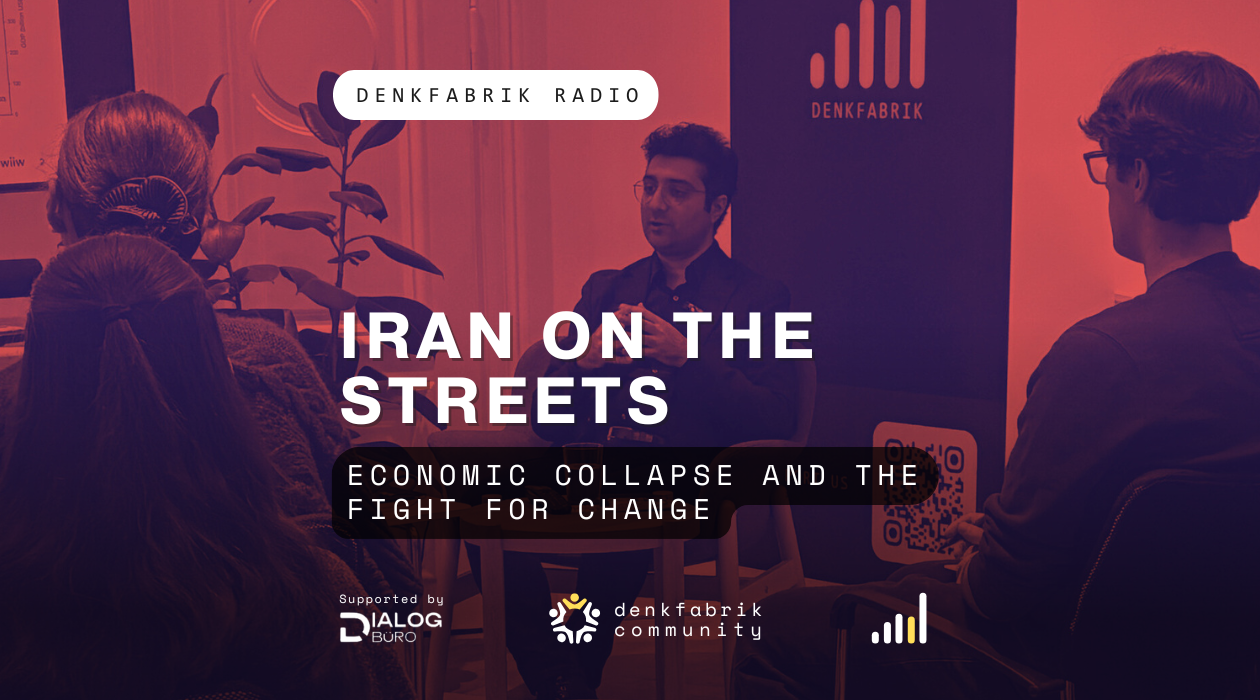
Across Iran, a powerful wave of anti-government protests is making headlines. Driven by soaring prices, a collapsing currency, lack of social freedom, and deep political frustration, people are taking to the streets in record numbers. While some see this as the beginning of the end for the current regime, the state has met the movement with internet blackouts and a violent crackdown.
Do we witness a turning point for Iran, or will the state’s grip remain firm? To understand it, we invite Mahdi Ghodsi, an economist and Middle East expert.


See the transcript
The Human Toll and Historical Context of Suppression
We have passed a few weeks of horror in Iran, terror and horror. And we have mixed feelings. It’s a dilemma for us. We are happy because the movement is ongoing. The revolutionary process started in 2009 or even earlier is still continuing. So it gives us hope. But we are also sad because many people got shot and died. And this is the most horrific event, let’s say, the most horrific suppression after the World War II in terms of intensity within one and a half night, one and a half day, 36,000 people are reported to being killed. So I want to give you a historical perspective so that we understand why we are here, why Islamic Republic, what Islamic Republic has done. And I will focus on economic issues because the trigger of this recent protest was… economic issue and economic concern. So I start with some graphs and I actually will give you some graphs and at the end I will give you also some recent analysis that we’ve done for a think tank in Germany just recently, just starting two weeks ago. It was a very crash project that we did at the way it was for one and a half week and we submitted the report on Sunday and the report was given to German Chancellor. So this is an economic benefit, cost-to-benefit analysis of an economic transition in Iran.
From Peak to Paralysis: The Economic Legacy of 1979
This picture is giving us the GDP per capita. And for those who don’t know what GDP is, it’s gross domestic product. It’s the whole production in one single country that is measured. But of course, because Iran has had inflation, if you adjust for inflation, so if you cancel out inflation and price changes, and if you just take one currency for one single year so that currency and inflation do not change, you can see this picture for Iran’s GDP. So if you control for changes of prices and currency, you can see that the income per capita divided by the population was peaking in 1976, which is here. So 1976 was the year that Shah of Iran at that time was able to sell lots of oil. Iran was the largest exporter of oil in OPEC. 20% of oil production was produced by Iran, 5.9 million barrels per day. So currently Iran is producing 2.5 or 3 million barrels per day. But that time it was producing almost 6 million barrels per day, 20% of OPEC’s production.
And so the whole income that Iran was enjoying, just after three years, in 1979, around here, Iran witnessed a revolution. That was called Islamic revolution afterwards because Islamic Republic was established afterwards. But it was not an Islamic revolution. It was a revolution because people wanted to have political freedom. So Shah did manage well in economic terms and in social freedom. So there were plenty of economic freedom and social freedom. Of course, there was corruption because it was a monarchy. So it was a rent-seeking monarchy. But the corruption was not as much as today. He was developing Iran. I will show you in the next photo how he was developing. But of course, there was no political freedom. So people wanted political freedom. People wanted actually democracy. So a group of people who were intellectuals or intelligentsia of that time, they were supporting leftist movements because they were anti-imperialism. They were anti-United States. They were anti-West. So those parts of society, they were leftists and… they were somehow leaning on Soviet Union at that time.
The Rise of Theocracy and Early Economic Shocks
And there was another part, which was clerical and the Islamists who were following Khomeini, and Khomeini was in exile in France. So Khomeini was in exile for about 15 years because Shah sent him to Iraq and then to Turkey, or I think it was first Turkey and Iraq, and then in France. So revolution started before 1979 with these two groups of people. But at the end, after the revolution, or a few days before revolution, it was like Khomeini, who was the leader of the other part, the Islamic part, took the control of everything, and everyone considered him as a leader of revolution. So then after the revolution, it became an Islamic constitution, a theocracy. So I’m not talking about how it happened, but it became a very cruel theocracy, so that from the first few months, They started killing. They started cleansing the previous people of the regime from the time of Shah. And they started hanging those. And other people, other factions of society also supported them.
So remember that time, it was the time that many countries have still had executions, including European countries, including many other countries in the world. They had executions. So execution was not something bad. So they cleansed many people. confiscated assets of many people that were close to Shah at the time of Shah and they flew away after the revolution. So the productive capacity of Iranian economy got completely confiscated and it completely got out of hand in economics. So the reason that you see a fall in GDP per capita was one of the issues was that Iran was not working. It’s like the economic activity was completely paralyzed in the first one or two years. Iran was not able to sell oil. In the first year after the revolution, there was a hostage crisis, meaning that the people who were supporting Khomeini, they went to the U.S. embassy and they took hostage, the people in the U.S. embassy. And those hostages were taken as hostage for, I think, 444 days. I’m not sure if it was accurate, but it was 400 days. During that hostage crisis, even U.S. tried to have military mission and be able to rescue those hostages, but they were unsuccessful. And it was the first time that U.S. sanctioned Iran. So sanctioned started then.
The Impact of War and the Reconstruction Era
And because sanctions started then, no business, no U.S. business could do business with Iran anymore. Of course, there was some trade, like they were trading foodstuffs, they were trading medicine, medical equipment since then, because those products are not targeted by sanctions. But sanctions started then. So business relationship between US and Iran got completely hampered. Before the revolution, the most foreign direct investment in Iran was coming from United Kingdom and United States. They were running oil factories. They were running oil fields, gas fields in Iran. So that’s why Iran was capable of exporting and producing that much oil. But after that, US got out. After that, Europe and other nations like United Kingdom got out. So that’s why there was a… huge reduction after that just two three years after the islamic revolution a war was imposed by iraq so i’m not talking who was triggering that war but the the war took eight years and millions died there was a huge destruction of infrastructure in iran so that’s why until 1988 which was the the year that the war ended you see that gdp per capita was sliding so here it was the lowest GDP per capita you see historically since 1964 or something.
After the war finished, the Iranian leader also changed from Khomeini to Khamenei. And since then, Rafsanjani took the presidency of Iran. Rafsanjani was a cleric who was supporting revolution before the revolution. He was very affluent. He was wealthy. So he knew how to work in economics. He knew business. So when he started his presidency, the reconstruction era of Iran started. So that’s why you can see here that GDP per capita was going on and peaking. So Rafsanjani was building lots of infrastructure, including dams. But those dams were built without expertise. So that’s why those dams cause lots of irrigation problems in Iran. And that’s one of the reasons that Iran is facing a huge amount of drought, water bankruptcy.
The Failure of Reform and the Shift to Nuclear Sanctions
So after Rafsanjani, because at the time of Rafsanjani, Khamenei took power and he reformed the constitution into his own benefits. So he consolidated his power. So Khamenei became more powerful than Khomeini. And exactly then, after Rafsanjani, a reformist president wanted to make some reforms, make Iran more democratic. His name was Khatami. He established something new in the international community to show a better face of Islamic Republic. He started negotiating with the West. He started working with the West. But it was 2001. It was 9-11 happening at that time. And when 9-11 happened, Bush called Iran the axis of evil, including Afghanistan and Iraq. Then there was an attack in Afghanistan. There was an attack in Iraq. Then that was a time that a reformist president wanted to make changes. But foreign intervention around Iran made the consolidation of power at the hand of Khamenei more and more.
The first kind of movement and uprising by students took place at that time because Khamenei wanted to confiscate and close some of the newspapers, but his students… went on the streets and they protested against that. So it was one of the most first crackdown against the protests and against democratic movement. So it started actually, the revolutionary process started then around 2000 something. But Khatami did very well. So the rise of GDP per capita that you observe in eight years of Khatami’s presidency was because he was reforming. He was making a better face with the West. He was inviting foreign direct investment. So because production capacity was improving, Peugeot, Renault, Total, many companies invested in Iran, they managed to increase economic activity. So he managed to increase employment, but his reform became unsuccessful.
So that’s why afterwards, Ahmadinejad became a populist president who… tried to oppose reforms, who tried to oppose West, who tried to increase nuclear activities of Iran. So in 2006 and 2007, first sanctions on Iranian nuclear activity by the United Nations, by the United Nations Security Council, were imposed in 2006. So before that, it was a sanction only by the U.S., but then in 2006-7, there was a sanction by the UN Security Council. In 2011, then, European Union joined sanctions, and European Union imposed more stringent sanctions, including sanctions on financial transactions, cutting Iran from SWIFT transactions, sanctioning central bank. So it was a paralyzing sanction that was initiated by the European Union. So that’s why you see there are some changes, and the increase in GDP per capita was halted here.
Extractive Institutions and the Privatization of Poverty
So I mentioned that Shah managed to sell lots of oil. So this graph is showing us how the income of the whole country is distributed in different segments. One of the most important segments is of course consumption. At the time of Shah, you see, there’s a huge key in investment. So Shah was investing a lot, about 90% of GDP. It’s 90% because net exports was negative. So it’s a huge amount of GDP, like half of the GDP in absolute terms, that he was spending in form of investment. But gradually, these things after the revolution got completely overshadowed by consumption. So Islamic Republic became a populist regime.
He didn’t want to develop country. He just wanted power. And he managed well. He managed to make Iran a consumerist country rather than developing. country. It was not developing. So it’s not even a developing country, in my opinion. It’s not an emerging economy. It’s becoming less and less developed. At the time of Ahmadinejad, it was 2006, 2007. It was one of the largest oil prices in the history. And Iran was managing to sell lots of oil, getting lots of revenues. But instead of investing in development plans, in infrastructure, in these kinds of things that Shah was doing, he spent it on transfer, cash transfers, subsidies. So he was giving people money.
This regime started to become an extractive institution from day one. They became extractive in the sense that they extracted the political rent from the society. If you consider the size of public economy around here, it’s about 80 to 85% of GDP. It controls the whole economy. There is no private sector there. Private sector is completely pushed away because of sanctions, because of bad economic conditions. In 2011, when EU started intensifying sanctions up to 2012, the exports completely fell from 20 billion, more than 20 billion, to less than 1 or 2 billion. Iran’s imports are becoming more expensive and that’s why it increases inflation.
Inflation, Currency Devaluation, and Social Unrest
The government is financing that public economy through sale of oil because there is only 15% of economy that is private. If oil price gets down, they can’t sustain it. If sanctions are there, they can’t sustain it. So what they should do, they can borrow money from the central bank. And the central bank simply prints money. And when central bank prints money without any backing, inflation kicks in. Another condition is that the government devalues currency intentionally so that at the end of the year, they can sustain and finance their budget. When they devalue currency, there are lots of products that are being imported to Iran, including food, livestock feed, medicine. These are humanitarian goods. If currency devalues, at least the price of these goods become more expensive.
At the time of Raisi, he canceled the preferential exchange rate. Suddenly, the prices of primary commodities, like cooking oil, it increased by 200%. Lots of other products that people needed increased by 200%. Minimum wage could not be increased by as much as inflation. So if you compare 2011 to today in terms of real income of some segments of society, it’s one third to one fourth of what it was. Poverty rate, according to official statistics, which is recent, is 36%, which I think it’s much, much larger. 60% of society, three years ago, they’re not able to get enough calories. There is a calorie deficiency in Iran, 60%. If you imagine 36% of people in the society cannot even take one meal per day. That’s the definition of poverty.
Until 8th January, so from 20th of December up to 8th January, the protests were scattered. But for the first time, the society found a call. The call was announced by Reza Pahlavi. On the 8th of January, they started protesting in millions. Then there was a complete digital blackout. Nobody understood what was going on. It didn’t continue because people saw each other being killed. And according to some figures that were some estimations of a healthcare system in Iran, they understood that it is 36,500 people that are being shot, that were shot, that were killed.
Quantifying the Economic Potential of a Transition
So what we did in this project that I mentioned, we wanted to see what happens if there is a regime transition, if Islamic Republic changes to a rules-based regime. So if this happens, it means that GDP per capita will reach what it was in 1976. It was 7,400. Now it is 5,000 something. So if it increases by 80%, it overpasses the pre-revolution GDP per capita. For Germany, if there are no sanctions, there is going to be 0.32%. It’s not negligible. It’s about $60-70 billion. It affects global economy by about 1%. So if there are no sanctions on Iran, nothing at all, global GDP will rise by 1%. That’s huge.
If we don’t remove sanctions, and if Iran becomes like Turkey in terms of productivity and efficiency, then Iran’s GDP will rise by 100%. But for Germany and EU, not much, because it’s not a sanction effect. And for global economy, it will rise by 0.65%. Of course, if it becomes Korea, Iran’s GDP will rise by 200%. For being Iran as efficient as Turkey, Iran’s GDP will increase by 240%. It becomes more than triple. And for Germany, it will increase Germany’s GDP by 0.50%. And for the whole EU by 0.53%. And for the whole global economy by 2.22%, which is very significant.
Development and the Path to Democracy
There are plenty of evidence in political science and social sciences, that the higher the GDP per capita of a country, the more developed it is, the higher the degree of democracy. In democracies, people contribute to political system because people contribute to its economy. So what I mentioned about extractive political system and extractive economic institution, they are going hand in hand. If they are not extractive, if they are distributive, if they are inclusive, they become democracy. If you deprive a society from economic well-being and GDP per capita declines like what it is in Iran, there is no civil society. Civil society is hampered by lack of development in the country.
For a country that is like Iran, if there is no economic development, people become poor. But it doesn’t mean that people do not have unrest. There is no political party in Iran. People are not part of any political party in Iran. So there is no political contribution at all. Because of that, there is no linkage between economic development and political contribution. But the people can be mobilized. These results do not tell us that sanctions should be removed with this system, with this regime. We need to first topple the regime and then remove the sanctions. If we don’t do that, of course, the society gets poorer. Of course, people feel pain. Of course, 50-60% of society cannot get enough calories. But at the same time, it was the rulers who were incoming, who were welcoming sanctions.
The Necessity of a United Front and Opposition Abroad
The sanctions, as I mentioned, there was a hostage crisis. Causality goes from the ruling regime to sanction. The ruling regime from hostage crisis, they invited sanctions. The ruling system at the time of Ahmadinejad, they invited sanctions by increasing their nuclear activities beyond peaceful measures. Still, the society can be mobilized. What the society need now is a united front. Opposition needs to be united. Otherwise, if there is any military confrontation, we will observe what was observed in Iraq, Libya, and Syria. The difference between Iran and these countries is that Iran, for now, has at least one leader, which is Pahlavi, which I don’t believe in him. I’m a non-monarchy democrat.
So that’s why I’m calling for unity. Setting aside all differences and think about unity because there is only one single enemy, which is the regime in Iran, Islamic State of Iran, which should be gone. The fracture and rupture should happen in the Islamic Republic and the unity should take place abroad so that there is no vacuum. If there is a united front in oppositions—in monarchists, non-monarchic democrats, ethnic classes—they can have a final word, and they can stand against the regime. But of course, the most important and the most peaceful way is preferred. It’s optimal. And the most peaceful way is demonstration of millions of society. Everyone should be involved. If you don’t do anything, we cannot change anything. A peaceful demonstration will take place only if everyone is united, only if everyone is willing to give up something. And I think that day is not far. It will come soon.
Leave a Reply