
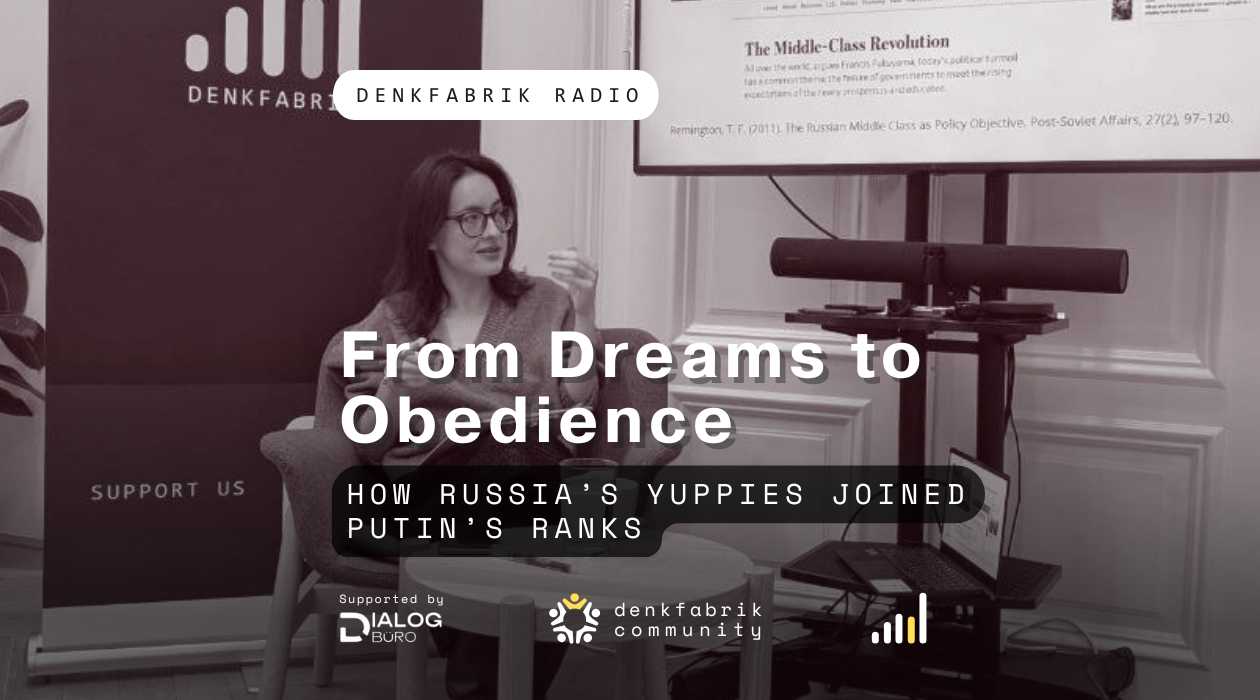
Traditionally, many saw the rise of a stable middle class as a key to political democratization—and Russia was no exception. Yet just a decade after the onset of civil protests of 2011-2013, many of the well-educated, urban professionals were within the ranks of Putin’s authoritarian state machine. What has become of those on whom so many hopes for Russia’s future once rested?
In this talk, Tamara Kusimova, PhD candidate at the Central European University and Junior Research Fellow at IGRec, examines the fate of young professionals and how did their pursuit for better life has put them in front of a dire choice: joining the state machine, leaving the country or being put in jail.


See the transcript
Researcher Profile and Methodology
My name is Tamara, and I am a cultural sociologist and anthropologist—sometimes a cognitive scientist, but not today. My dissertation is focused on the cultural meanings of upward mobility and success in contemporary Russia. Specifically, I am interested in people’s views regarding their future aspirations and ambitions, what they are ready to do to achieve them, and to what extent they are ready to compromise.
Today, I will talk about a topic related to my dissertation which can be broken down into several key narratives. I will attempt to present them in a coherent way, and you are welcome to ask questions after my talk. The data for this presentation is based on a combination of scholarly literature, secondary sources, and my own fieldwork materials from Russia. I will not include all references in my slides because that would result in too much text, but this presentation includes a reference list that I can provide if you are interested. I will also discuss some key books on the topic that may be useful for you.
Theoretical Expectations vs. Reality
As noted in the announcement, we will start with the idea that, until recently, mainstream social scientists and policymakers generally had very high expectations for the middle class. This was true not only for Russia; we saw similar expectations during the Arab Spring. The logic was that as income grows, a progressive, urban, pro-Western, and liberal middle class rises, which will eventually bring about better institutions, democratization, and positive overall changes. I am referring here not just to actual socio-demographic data, but to certain perceptions and representations. I believe even the Russian state once had high hopes for the middle class. We will find out where those ideas originated.
Defining the Middle Class
First, we need to define what we mean by the “middle class.” It is important to acknowledge that the term itself is politically charged, especially because of the positive expectations and associations tied to it. Sometimes it is confused with the concept of the “creative class”—a term I must admit I dislike. Against the backdrop of current structural economic transformations, there is also the idea of the “precariat” or the “precarious middle class.” These are slightly overlapping entities.
If we talk in terms of social stratification, there are various bases for ascribing middle-class belonging. Marxist theories define classes by their relation to the means of production. Weberian theories look at class plus status and belonging to specific groups. There is also Bourdieu’s theory of capitals, which is essentially Weberian, and Goldthorpe’s classification related to occupational categories and employment contracts.
In our case, we will define the middle class using credentials and occupation-based parameters. We are talking about educated professionals: people with higher education (or those in the process of obtaining it) working white-collar, professional jobs. This includes corporate employees, civil servants, teachers, doctors, and lawyers. We can discuss the limitations of this definition later.
The Roots of Modernization Theory
The high hopes for the middle class were not unfounded. A vast body of research in macro-historical and comparative sociology and political science shows that the emergence of a middle class often co-occurred with the development of non-extractive democratic institutions, less centralized power systems, and the emergence of stable democracies, mostly in Western Europe after World War II.
Prerequisites for a middle class include economic growth and rising incomes. While social science rarely deals with simple causal relations, modernization theories played a huge role in studies of democratic transitions in post-communist countries. The simplified view was that free markets would lead to prosperity, a middle class would appear, and democratization would follow.
I want to mention some key authors: Barrington Moore’s comparative study, Social Origins of Dictatorship and Democracy, compared the US, China, Russia, and France. He coined the phrase “No bourgeois, no democracy.” While not entirely accurate, it remains important. I also recommend the works of Seymour Martin Lipset, Acemoglu and Robinson (whose title echoes Moore’s), and Ronald Inglehart and Christian Welzel’s theory of modernization. If you have worked with the World Values Survey, you will recall how latent variables regarding values are related to levels of income and education. In Western countries, higher education and income generally increase the chances that individuals support pro-democratic or “emancipatory” values.
The Social Effects of Science and Misperceptions
When certain ideas become mainstream in research niches, they structure our perceptions and expectations. We sometimes reproduce these ideas unconsciously. This was evident during many protests in Moscow, Russia, and other countries like Georgia. Enthusiastic metaphors were used to describe protesters—such as the phrase “people with bright faces.” This is a “social effect of science”; it structures our expectations of reality.
However, the path to democracy in post-Soviet countries has been thorny, marked by shock therapy, poverty, violence, and conflict. We are currently witnessing a full-scale invasion of Ukraine. Even before this invasion—which marked Russia’s transformation from an authoritarian regime into a violent dictatorship—it was clear that things were not going well. My colleagues and I observed how the threshold of tolerance for political violence was gradually raised as repressive laws were passed. Protests occurred, but they did not grow. Why was there no backlash from the middle class? Why didn’t modernization theory work in the post-communist space or in countries like Indonesia and Malaysia?
State Dependency and the “Autocratic Middle Class”
Bryn Rosenfeld’s book, which I highly recommend, demonstrates using quantitative data from Russia, Kazakhstan, and Azerbaijan that it is vital to look at the sector where the middle class is employed. We can divide the middle class into those who are state-dependent and those in the private sector.
In authoritarian regimes, the state uses material incentives and workplace-based mobilization to suppress democratic demands. They encourage the middle class to support autocratic practices and elections. The state-dependent middle class includes white-collar workers in state and quasi-state firms (like Rostec or Roscosmos), as well as teachers, doctors, and civil servants. These groups are often overlooked by traditional modernization theories, which focus on urban education but ignore where the money comes from or how these people are tied to the state.
The State’s Penetration of the Private Sector
The ways the state penetrates the market are varied. A private company might be a major contractor for the state, which creates a serious form of dependency. For example, while researching this, I previously thought MTS (the telecom provider) was state-linked, but it is actually a private company. However, its main investor is AFK Sistema, which, while a private investment company, is closely connected to the state.
Since 2022, we have seen the state grow and consolidate. There have been many seizures of private companies, especially those that left Russia after the invasion. The State Prosecutor’s Office often orders the confiscation of these assets, which are then given to state-aligned patrons and elite groups. As the state expands its influence over the economy, both the current and aspiring middle class become increasingly dependent on state-linked opportunities for social mobility.
Personal Success as State Strategy: The Shift in Language
Let’s move from structural processes to everyday practices and how people experience these initiatives. Anthropologist Johanna Hammond conducted fieldwork in the late 2000s in Tver with the “Nashi” movement and visited the Seliger camp. She highlighted a gradual shift away from outdated propaganda—like “be a pioneer” or “be patriotic”—toward a language of personal success, self-realization, and upward mobility.
She observed workshops at Seliger that used managerial language: “social projects are good for your career and self-realization.” This shifted the focus to a globalized cultural narrative of ambition. The youth in these initiatives are not passive objects of propaganda; they exist in a globalized world and simply want good jobs and careers. They negotiate, resist, and reinterpret these programs.
Modern Technocratic “Social Lifts”
While Seliger and Nashi are in the past, new projects with significantly larger budgets have emerged. Between 2012 and 2022, these projects became less overtly political and more technocratic, focusing on academic or entrepreneurial ambitions. They became “neoliberal” in the sense that they tell you: “Join us, and you will be successful.”
It is important to note that these “social lifts” exist in many countries. In Austria and Germany, political parties have youth organizations that provide training and networking. However, in democratic countries, there are many competing actors and parties. In a centralized authoritarian system like Russia, there is only one authority with no competitors. This makes these naturally occurring institutions function very differently.
Case Study: “Aestheticized” Professional Success
The promotional language used by these programs resembles that of McKinsey or global talent acquisition programs. During my fieldwork in 2021, I spoke with youth from small towns who participated in programs like Sirius or Artek. Regardless of the ideological component, these people had positive experiences that provided real opportunities to enter prestigious universities. However, opinions are mixed; some participants noted that these environments can be very tough on self-esteem.
Anna Schwenck’s book, Flexible Authoritarianism, describes the practice of cultivating loyalty through a globalized entrepreneurial spirit. This “flexible strategy” is adopted by illiberal regimes around the world. They use American Dream-style ideas of individual success to win support while maintaining control over a centralized economy.
The Convergence of Lifestyle and Loyalty
To illustrate this, a colleague recently showed me a Telegram blog by a young woman who studied for her MA in Italy. Her blog used the “study blog” aesthetic found on Instagram or Pinterest—static pictures and tips on productivity. After returning to Russia post-2022, she became the head of the press service for the Valdai Discussion Club at age 26 or 27.
This is a massive career boost. This shows how the striving for a certain lifestyle and income converges with the opportunities offered by the state. Everything is aestheticized and looks very Western and progressive, yet it serves the state machine.
State-Led Competitions: “Leaders of Russia”
Since 2015, federal initiatives have expanded. There is “Senezh,” a management workshop for mid-career professionals with architecture designed by Western architects. There is the “Leaders of Russia” competition. In 2021, I missed the opportunity to participate for my fieldwork, which I regret. There is also “Russia – Land of Opportunity,” a massive foundation, and “GosVyshka,” a program at the Higher School of Economics that recruits talented youth for state service.
The promotional materials for “Leaders of Russia” use progressive narratives, such as “women in leadership,” featuring people with pink hair to look modern rather than conservative. This language appeals to the sensibilities of the middle class and those who aspire to join it. It suggests you can become successful while doing something good for your country.
Participants’ Voices: Opportunity or Skepticism?
Does it actually work? My interviews suggest it works for some. One participant already owned shares in a company and simply wanted to try something new in the Ministry of Ecology. Another person from a regional city was more skeptical.
We should pay attention to the fact that while these competitions are expanding, this “elite talent pool” is not yet allowed to reach the very top of the power structure. However, they do get good positions and salary premiums. The “Russia – Land of Opportunity” website offers everything from grants to “artistic self-realization” and help with developing blogs or getting points for university entrance exams.
Comparative Perspectives and Global Parallels
These trends are not exclusive to Russia. Similar programs exist in China, which also features state capitalism, a centralized state, and a middle class without democratization. China also uses “patriotic professionalism” and talent development programs to link economic growth with autocratic stability.
Preliminary Conclusions: The State-Stakeholder Relationship
In conclusion, we must pay attention to how the middle class is related to the state and whether they are stakeholders in state policies. The middle class is far from being an automatic agent of democratization. In many cases, especially with the global right-wing turn, the state is successful in consolidating the interests of the middle and upper-middle classes. These “social lifts” fit perfectly into neoliberal practices of self-realization.
Impact of the Full-Scale Invasion
What has happened since the full-scale invasion of Ukraine? There has been a massive redistribution of property to state-aligned clients. There is discussion about whether the war itself has become a social lift—for example, through volunteering or working in the government in occupied territories. We lack accurate statistics on this, and I would be cautious.
Early indications suggest that jobs in occupied Ukraine do not yet work as a meaningful social lift. More importantly, the costs of “exit” (leaving the country) or “voice” (protesting) are becoming much higher. A forthcoming book by my colleague, From Sovereigns to Servants, will detail how the war has reshaped the Russian elite. The state is becoming more violent, which will surely affect social mobility pathways, though we don’t yet know the full extent.
Leave a Reply